“Falling in Love Again, What Am I to Do?”

I know it's crazy, but I'm thinking of taking up with an old flame again. The voices of my friends and colleagues warn me, “You weren't happy. You were excited at first, we all got sick of you talking about it, but soon you felt unfulfilled and alone. We were just as sick of hearing about your disappointment afterward.” However, despite these well-intentioned warnings and the cautioning voices in my head, I feel myself being drawn back in, convinced it won't be the same, certain that I see real change, positive that we can make it work this time.

I'm seriously considering inviting Google+ back into my life.

Long time friends and readers of this blog will remember my excitement at the launch of Google's social network (I believe in my zeal I may have used the words, “Changed the world”). The ability to put contacts into “circles” and to carry on many levels of communication, seemed a perfect solution for the complicated communication graph of so many of us. I remember describing it as “Facebook with work clothes on,” as I promoted this service with friends and work associates with the desperate enthusiasm of an Amway distributer. I was forming circles with all my different groups of colleagues, and thinking about replacing other types of communication with the principals in my diocese with a huge Google+ circle.

But it didn't last. Ultimately three things soured me on my new love. First, the circles metaphor of choosing who could see individual posts and who you could see, which I found so attractive, proved impossible to explain to the casual user. I ended up setting up accounts for many of my friends and colleagues and handing it over never to be touched again. Second, the apps on iPhone and iPad were horrible, hard to follow and lacking essential functionality (for the longest time, the iPad app was simply a larger version of the iPhone app). As I moved away more and more from using a desktop machine, particularly for social networking, I was hampered with these tools and fell into Facebook and Twitter, both of which worked so well. Finally, despite the millions of users, there was a sense that no one was there. The platform seemed dedicated to technology focused individuals. Eventually I logged on less and less…drifting away with nothing but an icon on my screen to remind me of those heady days when I was completely smitten.

Recently, however, I've heard the siren song. G+ has changed it's functionality, benefits, and community. The metaphor of circles remains, but there is now an opportunity to create public or private communities. This allows me to invite and create a group easily without doing all the work myself. The iPhone/iPad apps are significantly better and beautifully support all the functions of the platform, including video conferencing. This video conferencing with up to 9 people has been improved to where it could be a real option for meetings and conferences. Probably because of these advancements, I've noticed more and more of my friends are adding G+ to their social media graph.

So, with a wary eye I'm binding up my heart and beating my way back to the Google+ door. I know that I might get burned again, but when it comes to a global social network, I wear my heart on my sleeve.

As always, I welcome your comments.

Image: 'Broken Heart' http://www.flickr.com/photos/15923063@N00/132922595 Found on flickrcc.net


A Wrinkle in Professional Development

Welcome to 2013! A year with an ominous number and endless possibilities! It's also one year closer to 2015, my stated goal year for 1:1 technology programs in all schools. As I look forward to this goal, I can't help but think of a comic from many years ago in which two professors stare at a board covered with a complex equation. The senior professor remarks that he has a question about the middle step where it is written THEN A MIRACLE HAPPENS. I know where we are today; I know where I want to be. The middle steps are still very blurry in my mind.

First among these “miracles” is faculty instruction and formation. In order to justify the cost of these devices as well as demonstrate their value, students must use their devices regularly for real purposes. Electronic textbooks will go a long way in this area. A good e-text should be self-explanatory and should provide established value at a competitive price. There are few effective arguments for staying with paper texts if an electronic reader is available. However, if electronic texts are the only use of the student machines, the value is greatly limited. This is a clear case of new wine into old wineskins, new technology used to perpetuate an old model.

No, if 1:1 is to be transformative, rather than iterative, it has to be part of a blended learning model. Blended Learning is a term describing a classroom or school where learning takes place using a combination of instruction strategies, including the use of technology. Though I'm not the largest fan of on-line courses (probably because I was never good at them) a technology based system can supplement other types of classroom instruction and provide adaptive, leveled instruction in ways that a single teacher never could. Students need to work with a teacher, with other students, and with a computer, all during the course of a school day.

However, in order to have an effective blended learning environment, we need teachers to guide it. How we give our current labor force the ability (not to mention the drive) to develop and present lessons using technology has been our mission and, to a great extent, our failure through the past decade. Imagining a time when the majority of teachers prepare live, collaborative, and on-line content is like dreaming of snow in the Bahamas.

But I'm tired of waiting, and our students can't wait any longer.

Maybe the problem is me (usually is); maybe I and other tech instructors have been approaching it the wrong way. For me, technology use is a function of a fully-integrated understanding and immersion in digital tools and options. To some extent, much professional development has been trying to create the same awareness and orientation in teachers. We've been teaching them how to build a radio, when all they want to do is play the radio.

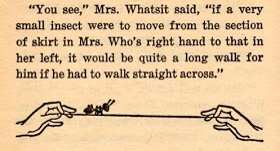
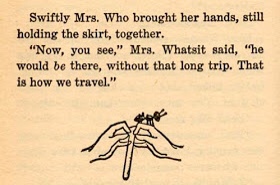
One of the most formative books of my childhood was Madeline L'Engle's A Wrinkle in Time. When I was thinking about this topic earlier, I pictured two illustrations from my 1960’s edition of the book. A quick Google search found them. I'm not certain about the legality of using these images, but I'll cite and hope for the best.

The images were used to illustrate travel by using the concept of the Tesseract, a way of compacting space as is seen below:


To move to an effective, widespread blended classroom model, we will need content providers to create products that comprehensively address the need for direct leveled student instruction and assessment. We can't wait for teachers to develop the tools for those students who are working at computers, nor can we rely on(or expect most teachers to understand) a kluge of free and unrelated apps and resources. There are many excellent teachers who can create this environment, but there are far more excellent teachers who cannot and will not. However, all teachers can be taught to guide students in the use of a well-developed program. We have to stop trying to urge the ant across the divide and put our fingers together to be there now!

The world of education business is a testing-obsessed culture. The amount of resources and money poured by publishers into the creation of the “perfect” standardized exams is wildly disproportionate to their educational value. Might I suggest that some of these resources be rerouted into the creation of integrated levelled instruction systems that can be used as part of a blended instructional program? My teachers do not have the ability or time to do this effectively. I don't have the time to do this effectively. Why, when I ask publishers for something like this, am I greeted with blank stares? I can describe exactly what we need…someone come and ask me!

I'm certain there will be some reaction that a structure like this would kill teacher creativity and create robot classrooms. I would argue quite the opposite. I am a strong proponent for the teacher led classroom, with teachers curating the tools that they are given, but I don't ask teachers to whittle their own quills or write their own textbooks (ignoring for the moment the arguments against traditional textbooks). Using technology to assist in student learning, particularly if the products (deliberately avoiding the overused apps) use proven methods of instruction, assessment, and reporting, can be a vital tool and essential component in a 21st century classroom.

21st century? We are THIRTEEN YEARS in already…it's time for us to stop seeing the goal from afar and to get there…now!

As always, I welcome your comments.

Image Credits:

  • Tesseract. http://www.flickr.com/photos/kowalskirsflickr/3158702666/in/photostream/. Cc
  • A Wrinkle in Time by Madeleine D'Engle, Scholastic, 1962